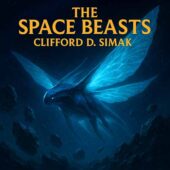
Clifford D. Simak

Biography
Clifford D. Simak (1904–1988) was an American science fiction author whose gentle yet profound stories earned him recognition as one of the field’s great humanists. Over a career spanning more than 50 years, he became known for blending pastoral settings, small-town values, and a deep concern for humanity with cosmic wonder and speculation. His works often explored the tension between progress and tradition, the possibilities of extraterrestrial life, and the resilience of the human spirit.
Born in Millville, Wisconsin, Simak grew up in rural America, an environment that shaped his lifelong fascination with the countryside, nature, and simple community life. These elements became hallmarks of his fiction, setting him apart from many contemporaries who favored galactic empires and futuristic urban landscapes. Simak worked for decades as a newspaperman, spending much of his career at the Minneapolis Star and Tribune, and his journalistic discipline carried into his fiction—clear, precise prose and an eye for everyday detail.
He began publishing science fiction in the 1930s, with his first story appearing in Wonder Stories in 1931. His early works reflected the pulp traditions of the time, but by the 1940s and 1950s, Simak had developed a more personal style—quiet, philosophical, and suffused with both optimism and melancholy. His breakout came with the story cycle later collected as City (1952), a series of linked tales spanning thousands of years in which dogs inherit Earth and recount myths of humanity’s vanished past. City won the International Fantasy Award and remains one of his most famous and haunting works, raising questions about evolution, memory, and what it means to be human.
Throughout his career, Simak produced acclaimed novels that balanced speculative adventure with meditative themes. Way Station (1963), about a Civil War veteran who becomes caretaker of an interstellar transfer station hidden in rural America, won the Hugo Award and is still regarded as his masterpiece. Other notable works include Time Is the Simplest Thing (1961), All Flesh Is Grass (1965), and A Heritage of Stars (1977), all of which combine far-reaching ideas with his signature compassion and pastoral imagery.
Simak’s short fiction was equally influential. Stories like “The Big Front Yard” (1958), which won a Hugo Award, and “Grotto of the Dancing Deer” (1980), which earned both the Hugo and Nebula Awards, reveal his versatility and emotional depth. The latter, about an immortal man quietly living among humanity, exemplifies Simak’s recurring interest in memory, loneliness, and endurance. His ability to bring warmth and humanity to science fiction distinguished him during an era often dominated by harder, more mechanistic visions of the future.
Though sometimes overshadowed by contemporaries such as Isaac Asimov, Robert Heinlein, and Ray Bradbury, Simak carved a unique niche in the genre. His rural sensibilities and focus on ordinary people confronting extraordinary circumstances made his work accessible and enduring. While his stories featured aliens, robots, and cosmic scales, at their core they asked deeply personal questions about morality, coexistence, and the value of community.
Simak received numerous honors during his lifetime. He won three Hugo Awards, a Nebula Award, the Bram Stoker Award for Lifetime Achievement, and in 1977 was named a Grand Master by the Science Fiction Writers of America—their highest honor. These accolades reflected not only the quality of his individual works but also his consistent contribution to the growth of science fiction as a respected literary form.
In addition to his fiction, Simak remained a full-time journalist until his retirement in 1976. He often said that reporting kept him grounded in reality, while writing science fiction allowed him to explore possibilities beyond it. This dual career gave his stories a distinctive balance: imaginative yet believable, speculative yet rooted in the rhythms of everyday life.
Clifford D. Simak passed away in 1988, but his influence endures. Writers such as Ursula K. Le Guin, Kim Stanley Robinson, and contemporary authors of “pastoral science fiction” have cited him as an inspiration. His vision of small-town life intersecting with cosmic mysteries continues to resonate with readers seeking thoughtful, humane alternatives to dystopian or militaristic science fiction.
Simak’s legacy is that of a quiet giant of the field—a storyteller who proved that science fiction could be as much about compassion, community, and moral reflection as it was about technology and adventure. From the mythic scope of City to the intimate poignancy of Grotto of the Dancing Deer, his works invite readers to imagine a future where progress does not mean abandoning humanity, but rather rediscovering its best qualities. In doing so, Clifford D. Simak secured his place as one of the genre’s most enduring and beloved voices.