Damon Knight
Biography
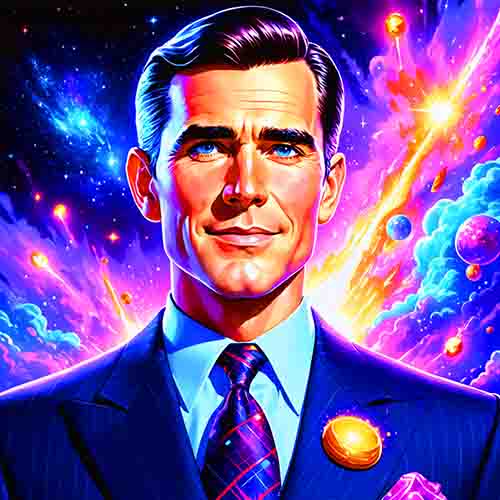
Damon Knight (1922–2002) was an American science fiction author, critic, and editor whose influence on the genre was wide-ranging and profound. Though a talented writer of short fiction himself, Knight is equally remembered as a fearless critic, a pioneering editor, and a tireless advocate for science fiction as a serious literary form. His career helped shape the field across the mid-20th century, and his legacy is permanently enshrined in the Damon Knight Memorial Grand Master Award, the highest honor given by the Science Fiction and Fantasy Writers of America (SFWA).
Born in Baker City, Oregon, Knight grew up in Hood River, where he discovered science fiction at an early age. By his teens he was contributing art and fan writing to fanzines, immersing himself in the vibrant science fiction fan community. He sold his first professional story, “Resilience” (under the name Stuart Fleming), in 1941, though it wasn’t until after World War II that he established himself as a professional writer.
Knight’s fiction was marked by wit, irony, and sharp social observation. One of his earliest major successes was “To Serve Man” (1950), a darkly humorous tale of alien benefactors that ends with one of the most famous twist endings in science fiction. The story was later adapted into a classic episode of The Twilight Zone, cementing its place in popular culture. Other notable works include Hell’s Pavement (1955) and The People Maker (1959), as well as short stories like “Four in One” and “Not with a Bang.” While he produced several novels, Knight always considered the short story his best form, preferring the compression and focus it allowed.
As influential as his fiction was, Knight’s work as a critic was even more transformative. His 1956 collection of essays, In Search of Wonder, set a new standard for science fiction criticism. In these reviews, Knight approached the genre with both love and rigor, praising excellence while mercilessly calling out lazy writing, poor science, or weak characterization. His honesty and biting humor earned him a reputation as science fiction’s most feared reviewer. Yet his critiques also helped elevate the genre by insisting that it be held to higher artistic standards, paving the way for the literary credibility science fiction later achieved.
Knight was also a groundbreaking editor and anthologist. He edited the influential Orbit anthology series from 1966 to 1980, which became a showcase for experimental and innovative science fiction during the New Wave period. Through Orbit, Knight helped promote authors such as Ursula K. Le Guin, R. A. Lafferty, and Gene Wolfe, giving them platforms for some of their most significant early work. His editorial vision encouraged bold, unconventional storytelling and expanded the boundaries of the field.
Perhaps Knight’s most lasting institutional contribution was his role in founding the Science Fiction and Fantasy Writers of America (SFWA) in 1965. As its first president, he helped establish the Nebula Awards and created an organized community for professional science fiction and fantasy writers. His advocacy for fair treatment of authors, better contracts, and higher professional standards had a long-lasting effect on the field.
Knight was also a mentor and teacher, co-founding the Clarion Writers’ Workshop in 1968 with Kate Wilhelm, his wife and fellow writer. Clarion became one of the most prestigious training grounds for aspiring science fiction and fantasy authors, nurturing new generations of talent and reinforcing Knight’s role as a guiding figure in the community.
Over his lifetime, Knight received numerous honors. He won a Hugo Award for criticism, a Nebula Award, and in 1995 he was named a SFWA Grand Master for his lifetime contributions. Following his death in 2002, the award was renamed the Damon Knight Memorial Grand Master Award in his honor, ensuring his name would forever be linked with the highest recognition in the field.
Knight’s legacy is that of a true multifaceted force in science fiction. As a writer, he produced memorable stories that combined sharp ideas with biting wit. As a critic, he demanded excellence and helped raise the genre’s literary stature. As an editor, he championed innovation and helped shape the careers of future greats. And as an organizer, he built institutions—SFWA and Clarion—that continue to support and guide writers today.
Damon Knight proved that science fiction could be both imaginative entertainment and serious literature. His life’s work helped push the genre toward maturity, and his influence endures through his stories, his critical writings, his students, and the award that bears his name.