Donald E. Westlake

Biography
Donald E. Westlake (1933–2008) was an American writer best known for his masterful crime fiction, particularly his witty comic capers and his darker, hard-boiled thrillers written under pseudonyms. Over a career that spanned more than half a century, he produced more than 100 novels and short stories, winning multiple Edgar Awards and cementing his reputation as one of America’s most versatile and entertaining storytellers. While crime fiction was his primary domain, Westlake also wrote science fiction during his early career, including the memorable short story “The Spy in the Elevator” (1961).
Born in Brooklyn, New York, Westlake grew up during the Depression and developed a love of books and storytelling early. After attending Champlain College and briefly working a variety of jobs—including as a laborer, truck driver, and employee at a literary agency—he turned to full-time writing in the late 1950s. Like many young writers of his generation, Westlake began by contributing to the pulp and digest magazines that flourished in the postwar years.
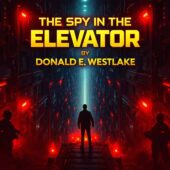
It was during this period that he published “The Spy in the Elevator,” a science fiction short story that appeared in Analog Science Fiction and Fact in 1961. The story imagines a future where the remnants of humanity live sealed inside towering, regimented apartment blocks after a global war has devastated the surface. The tale follows a young man who becomes entangled with a mysterious “spy” from another building, forcing him to confront both the rigid conformity of his society and the fragile hopes for human connection. The story showcased Westlake’s flair for satire, irony, and claustrophobic tension, qualities that would later define much of his crime writing. Although Westlake did not pursue science fiction for long, “The Spy in the Elevator” remains one of his most anthologized works in the genre and a fascinating glimpse into his early voice as a writer.
Westlake’s breakthrough, however, came in crime fiction. His early novels included tough, lean thrillers under the pseudonym Richard Stark, beginning with The Hunter (1962), which introduced the relentless professional thief Parker. The Parker series became legendary for its stripped-down prose, amoral antihero, and unflinching look at the criminal underworld. These books influenced later generations of crime writers and filmmakers, inspiring adaptations such as Point Blank (1967, starring Lee Marvin) and Payback (1999, starring Mel Gibson).
At the same time, under his own name, Westlake developed a second, wildly different mode: comic crime capers. Beginning with The Fugitive Pigeon (1965) and perfected in the long-running Dortmunder series, Westlake turned heists into hilarious misadventures, starring criminals whose schemes inevitably went wrong in spectacular fashion. The Dortmunder novels, starting with The Hot Rock (1970), became some of his most beloved works, combining sharp plotting with laugh-out-loud humor.
Throughout his career, Westlake demonstrated astonishing range. He wrote standalone thrillers, comedic novels, screenplays, and nonfiction. His ability to balance gritty noir with comedy was unparalleled. He won three Edgar Awards from the Mystery Writers of America—for best novel, best short story, and best screenplay—and in 1993 he received the association’s Grand Master Award, the highest honor in American crime writing.
Hollywood also recognized his talent. Westlake wrote screenplays for films such as The Stepfather (1987), a chilling thriller, and The Grifters (1990), adapted from Jim Thompson’s novel, which earned him an Academy Award nomination. He also wrote the screenplay for The Hot Rock (1972), adapted from his own novel.
Despite his fame in crime fiction, Westlake’s science fiction work has enjoyed a second life, especially in anthologies. “The Spy in the Elevator” continues to resonate with readers as an example of mid-20th-century dystopian fiction, reflecting Cold War anxieties about nuclear war, authoritarianism, and loss of individuality. The story also demonstrates Westlake’s early mastery of dialogue and human tension—traits he would carry into his crime novels.
Westlake was famously prolific, publishing under at least a dozen pseudonyms, including Richard Stark, Tucker Coe, Samuel Holt, and Curt Clark. This allowed him to experiment with tone and style, moving effortlessly from the bleak to the comedic, from the satirical to the suspenseful. His productivity was matched by his craftsmanship: even his lighter works are tightly plotted and filled with sharp characterizations.
Donald E. Westlake died in 2008 while on vacation in Mexico, leaving behind an extraordinary legacy of crime novels, comic heists, and unforgettable characters.
Legacy: Westlake is remembered primarily as a giant of crime fiction, the rare writer equally adept at dark noir and farce. His Parker novels remain touchstones of hard-boiled minimalism, while his Dortmunder series defines the comic caper. Yet his early work in science fiction, particularly “The Spy in the Elevator,” shows his versatility and ability to adapt genre conventions to his own unique vision. Though he ultimately chose crime as his field, his brief contributions to speculative fiction highlight the breadth of his imagination.