Hide and Seek by Arthur C. Clarke Episode #419
Arthur C. Clarke | September 8, 2025-
play_circle_filled
Hide and Seek by Arthur C. Clarke Episode #419
Arthur C. Clarke
HIDE AND SEEK
Episode #419 · Written by Arthur C. Clarke · Narrated by Scott Miller
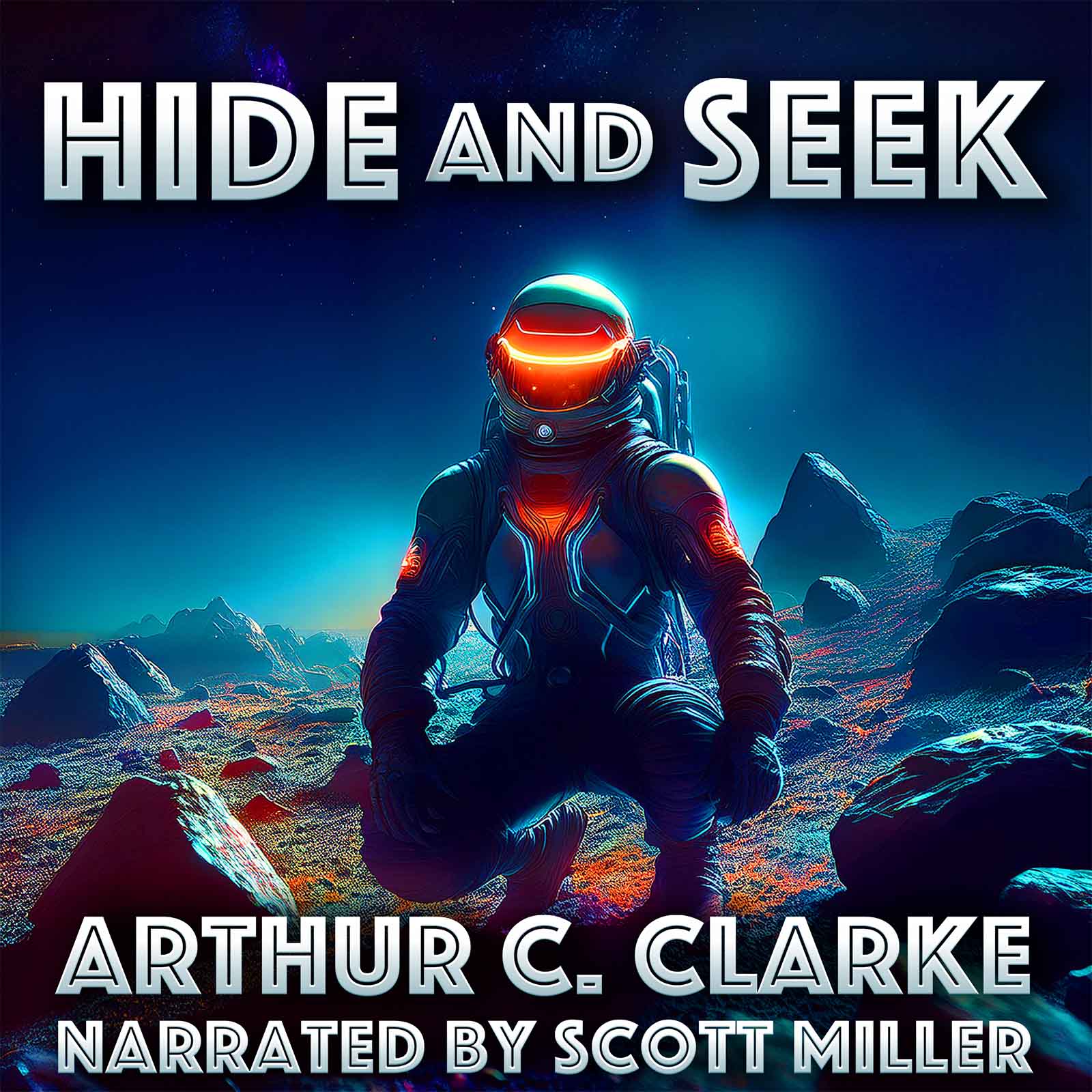
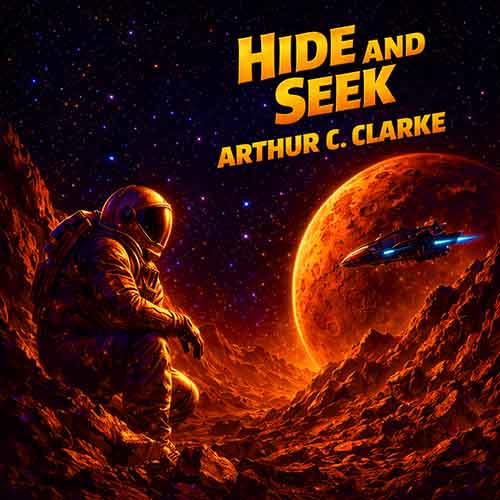
A lone intelligence agent must survive on the jagged, airless surface of Phobos while a deadly cruiser stalks him across the stars. With nothing but a spacesuit, his wits, and the moon’s terrain, he turns a desperate chase into a high-stakes game of cosmic hide-and-seek.
K.15 is alone—stranded on the rough, shadow-carved surface of Phobos, the tiny inner moon of Mars—while a heavily armed Z-class cruiser closes in behind him. His escape ship is gone, his fuel is spent, and his only path to survival lies in turning an entire moon into his hiding place. Equipped with nothing more than a spacesuit, a handful of emergency supplies, and a mind sharpened by desperation, he enters a deadly celestial chess match. The cruiser’s commander can unleash guided missiles, heavy electromagnetic guns, and precision tracking systems, but he faces an unexpected problem: K.15’s mobility and the stubborn physics of maneuvering a massive warship around a twenty-kilometer-wide, almost weightless lump of rock.
Clarke transforms the terrain itself into a character—shifting shadows, towering ridges, and the looming crescent of Mars all become tools in K.15’s arsenal. What begins as a pursuit becomes a stunning demonstration of orbital mechanics, geometry, and nerve. Each rotation of Phobos resets the board, each missile becomes a blind hunter, and each shift of sunlight brings new dangers. Clarke’s storytelling blends tension, strategy, and imagination, creating a smart and thoroughly engaging drama of survival and ingenuity.
Arthur C. Clarke’s talent shines through in every detail. His ability to find drama in scientific realities—like rotational inertia, rocket torque, and line-of-sight communication—sets him apart as a master of the genre. “Hide and Seek” represents the best of Clarke’s mid-century storytelling: tight, clever, and grounded in plausible science. It is a reminder that the vastness of space doesn’t diminish human struggle—it amplifies it.
ABOUT THE AUTHOR
Arthur C. Clarke (1917–2008) stands as one of the giants of science fiction, widely respected by readers, scientists, and futurists alike. A visionary thinker, Clarke predicted communication satellites long before they existed, co-created 2001: A Space Odyssey with Stanley Kubrick, and wrote enduring works like Rendezvous with Rama and Childhood’s End. His style blends wonder, scientific precision, and philosophical depth, exploring not only humanity’s future among the stars but also the forces—technological, social, and cosmic—that shape our destiny. Clarke’s influence extends across generations, inspiring countless readers, filmmakers, space advocates, and dreamers. His legacy endures in every story that invites us to look upward and imagine what comes next.
LISTEN TO THE STORY
Listen to this vintage science fiction adventure, Hide and Seek by Arthur C. Clarke, where a lone agent on Phobos must outwit a powerful space cruiser in a deadly pursuit.

ARTHUR C. CLARKE SHORT STORIES
Arthur C. Clarke was one of the most influential figures in science fiction and a key architect of the genre’s modern identity. Born in 1917 in Somerset, England, Clarke combined rigorous scientific thinking with a sense of cosmic wonder that reshaped how readers imagined space, technology, and humanity’s future. His work helped define what is now known as “hard science fiction,” grounded in plausible science and forward-looking ideas.
During World War II, Clarke served in the Royal Air Force, working with radar technology, an experience that deeply influenced his later writing. In 1945, he published a paper describing the concept of geostationary communication satellites, a proposal that would later become a foundational element of global telecommunications. Alongside his fiction, Clarke remained an active science writer and futurist throughout his life.
Clarke’s fiction spans intimate short stories and sweeping cosmic visions, often exploring humanity’s place in a vast and indifferent universe. His collaboration with Stanley Kubrick on 2001: A Space Odyssey cemented his legacy in both literature and film, while stories like “The Star” and “The Nine Billion Names of God” remain enduring classics of vintage science fiction.
- The Nine Billion Names of God by Arthur C. Clarke
- A Walk in the Dark by Arthur C. Clarke
- Encounter in the Dawn by Arthur C. Clarke
- Exile of the Eons by Arthur C. Clarke
- Summertime on Icarus by Arthur C. Clarke
- The Wall of Darkness by Arthur C. Clarke
- Superiority by Arthur C. Clarke
- No Morning After by Arthur C. Clarke
- At The End of the Orbit by Arthur C. Clarke
- Hide and Seek by Arthur C. Clarke
- Inside the Comet by Arthur C. Clarke
- The Parasite by Arthur C. Clarke
- Before Eden by Arthur C. Clarke
- The Star by Arthur C. Clarke
- Castaway by Arthur C. Clarke
- Travel by Wire by Arthur C. Clarke
- Transience by Arthur C. Clarke
ABOUT THE LOST SCI-FI PODCAST
The Lost Sci-Fi Podcast is the most listened-to vintage science fiction podcast in the world. Ranked the #1 Science Fiction Podcast in 34 countries and heard in more than 190 countries, the show has surpassed 3.8 million listens.
Each episode features carefully selected stories from the Golden Age of science fiction, professionally narrated. Timeless storytelling the way it was meant to be heard.
What listeners are saying:
★★★★★
“Fantastic Podcast. Can’t wait for each story. Every time I get in the car for the commute I check if I can listen to a new one! Brilliant stories, wonderfully read. Thanks Scott.”
— Why make it worse?
★★★★★
“Exceptional. The best scifi podcast I’ve come across. Fantastic stories are one thing, but I can’t count the number of times I have been disappointed by the quality of the voice acting. I am very happy to say, that the standard of both contained within these episodes is top notch. As is often the case, there are often elements within classic scifi that don’t age particularly well for numerous reasons, but they are few and far between. I think I will be blasting through the entire catalogue in no time and left waiting in anticipation for the next weekly addition. Great work!”
— blablahyaddayadda
Vintage science fiction. Professionally narrated. Carefully curated.
📬 JOIN LOST SCI-FI WEEKLY
35,000+ Listeners Can’t Be Wrong
Get vintage sci-fi stories, podcast episodes, and surprises every Monday.
FREE SCI-FI EVERY WEEK
✅ Check your email and confirm — that unlocks your free sci-fi downloads.
No spam in this galaxy. You can eject anytime.