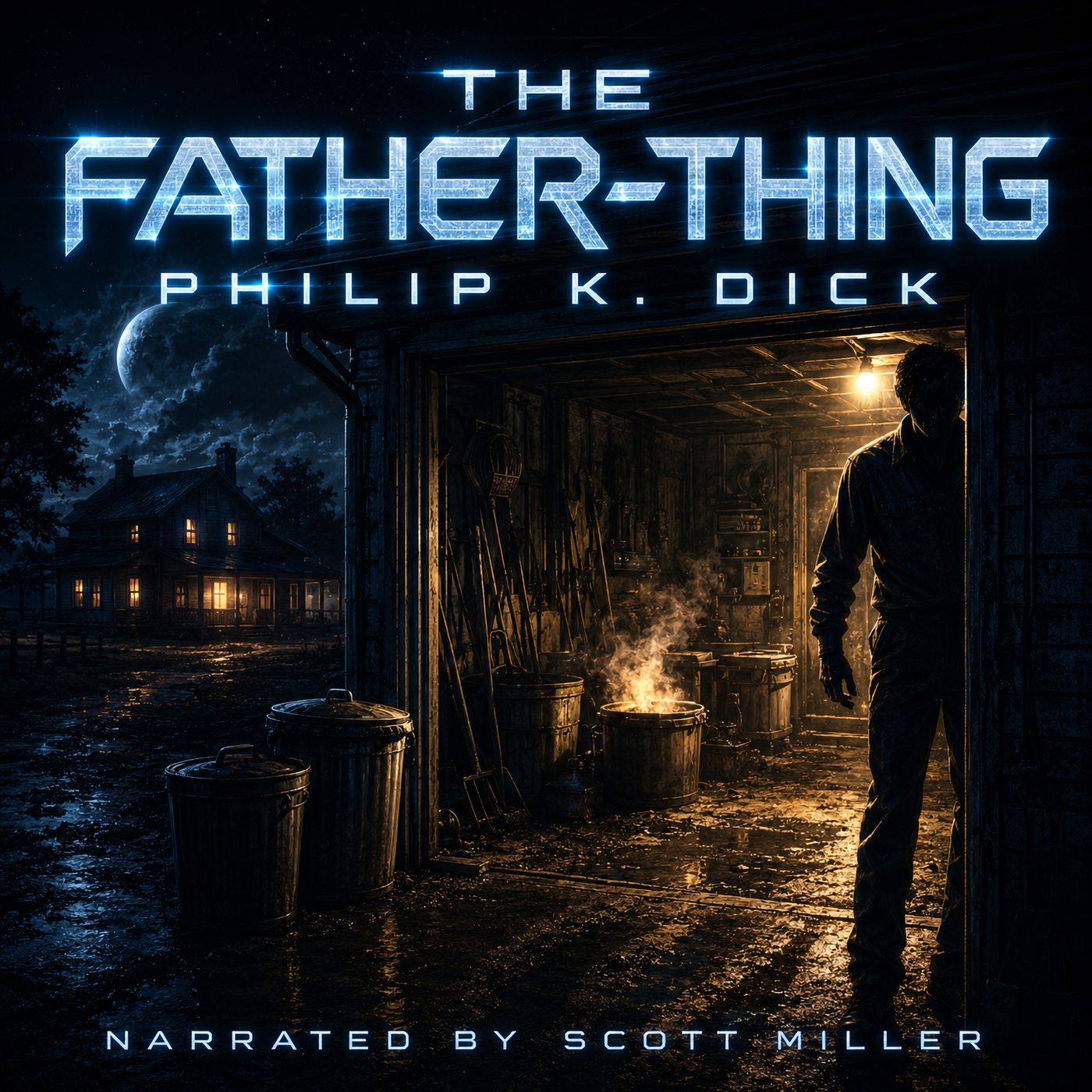
The Father Thing
A young boy realizes something terrifying has replaced his father. What happens next threatens not just his family, but the very nature of humanity itself.
Dinner is ready—but the man who walks in from the garage isn’t quite the same. His smile looks right. His voice sounds right. Yet something behind those eyes has changed. When young Charles Walton insists that there are two of his father, no one believes him—until it’s too late.
“The Father Thing” is one of Philip K. Dick’s most unnerving and memorable short stories, originally appearing in Fantasy and Science Fiction magazine in 1954. What starts as an eerie domestic mystery transforms into a nightmarish confrontation between innocence and invasion. Beneath its creature-feature exterior, Dick explores profound questions: What defines a person? Can something perfectly imitate love, memory, and humanity itself?
This story bridges two of Dick’s favorite territories—the paranoia of suburban life and the cosmic terror of forces beyond human understanding. Readers will recognize themes that echo through later works like Do Androids Dream of Electric Sheep? and The Three Stigmata of Palmer Eldritch. The setting may be small—a family home, a dark backyard—but the implications reach across the stars.
Philip K. Dick’s writing career spanned more than three decades, producing over 120 short stories and 44 novels. His explorations of altered states, parallel worlds, and counterfeit realities influenced generations of filmmakers, writers, and philosophers. In “The Father Thing,” he channels that vision into pure, visceral fear: the horror of seeing the familiar become the alien, of realizing that safety can be the most dangerous illusion of all.
Listen to The Father Thing by Philip K. Dick — a vintage science fiction tale of invasion, identity, and fear within the family. A classic sci-fi masterpiece reborn.
Next on The Lost Sci-Fi Podcast: A curious antique dealer discovers a strange crystal egg that reveals eerie glimpses of an alien world teeming with life. As he obsesses over its mysteries, he begins to question whether the visions are mere reflections—or a window into something watching him back. The Crystal Egg by H. G. Wells.
